396 vs 264
cards in the O-Pee-Chee set vs the Topps set
O-Pee-Chee of London, Ontario had long printed cards under license from Topps, turning out near-identical Canadian versions of the American sets. For the 1979-80 hockey season the arrangement produced two Gretzky rookies: card #18 in the 264-card Topps set sold in the United States, and card #18 in the larger 396-card O-Pee-Chee set sold primarily in Canada. Same photograph, same blue border, same young centreman labelled “WAYNE GRETZKY · C” above “EDMONTON OILERS.”
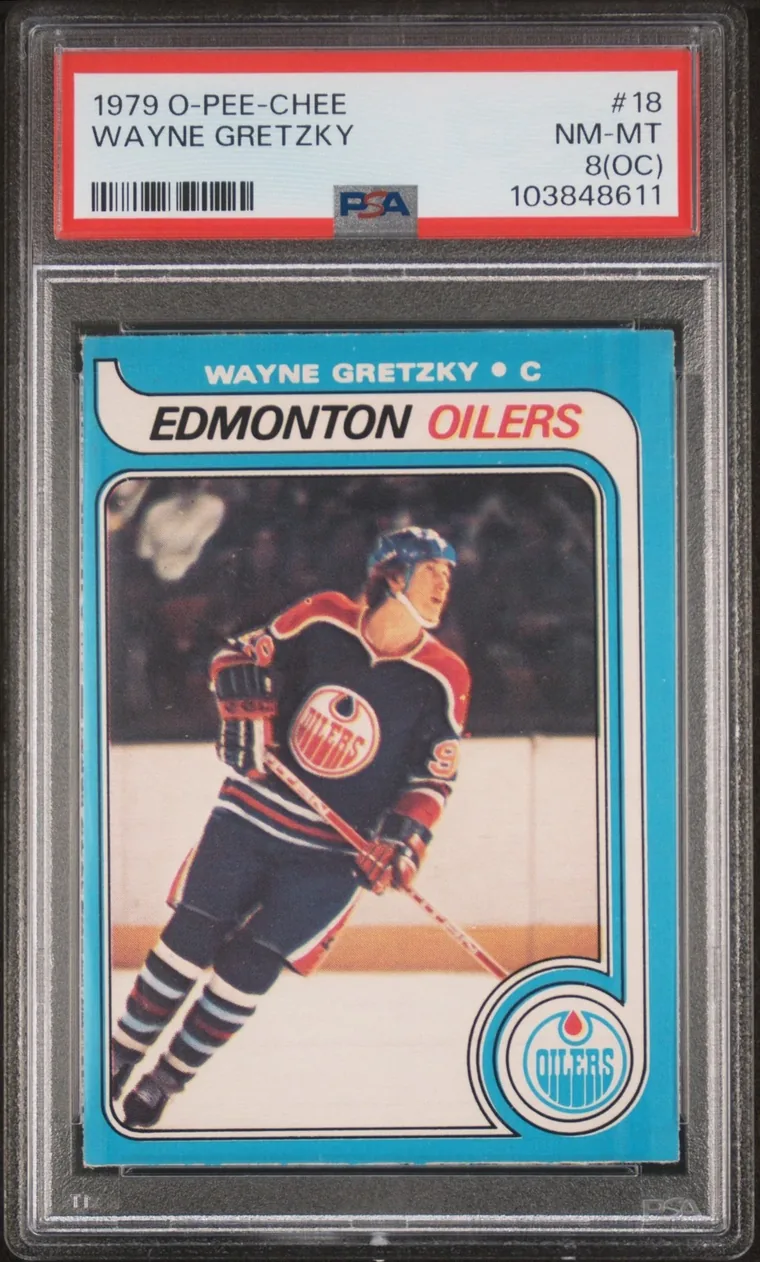
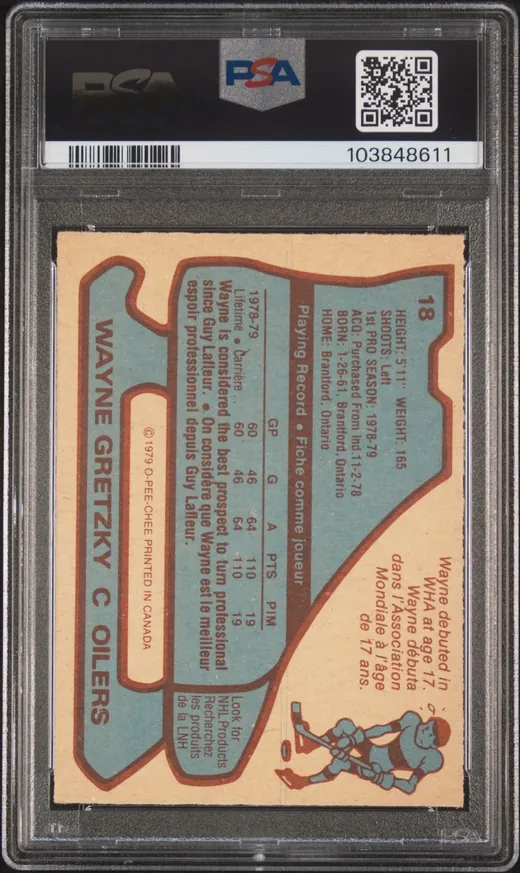
| TELL | O-PEE-CHEE | TOPPS |
|---|---|---|
| Back language | Bilingual English / French | English only |
| Shoulder dot | Small yellow print dot on Gretzky’s left shoulder, found across the authentic print run | Absent |
| Card stock | Whiter, brighter stock | Duller, darker stock |
| Edges | Rough, ragged cuts straight from the pack — PSA treats them as the card’s natural construction | Conventional clean blade cuts |
| Set | #18 of 396 | #18 of 264 |
The rough O-Pee-Chee edge deserves its own sentence, because it confuses first-time buyers in both directions. Authentic OPC cards of this era left the factory with jagged edges — the result of a cruder cutting process, widely described in the hobby as wire-cutting, that got worse as equipment dulled. A ragged edge is not damage, and a suspiciously smooth edge on a raw copy is a warning sign, not a virtue.
The story everyone repeats is that O-Pee-Chee printed far fewer cards for the smaller Canadian market, and that scarcity explains the premium. It might even be true — but no production records have ever surfaced, for either card, and the grading data refuses to cooperate with the legend. As of September 2026, PSA has graded roughly 15,700 O-Pee-Chee Gretzkys against roughly 12,100 Topps — the “scarce” Canadian card is now the larger graded population. As recently as February 2021 the two counts were nearly even. What changed is not the supply; it is the incentive. The O-Pee-Chee is worth grading at almost any condition, so into the holders it goes. Population reports measure submissions, not print runs.
Where the O-Pee-Chee genuinely is scarcer is at the top of the scale, and the production line is the reason. The rough cuts, the chip-prone blue border, the print defects and centering that PSA’s own CardFacts entry describes as “often 60/40 or worse” all conspire against high grades. As of September 2026 the O-Pee-Chee counts 95-odd PSA 9s and exactly two PSA 10s out of ~15,700 graded; the Topps, from a smaller pool, has more 9s (about 128) and its population peaks at grades 6–7, where the O-Pee-Chee’s peaks at 4. The American card simply survived better; the Canadian card made survivors rare.
| DATE | CARD | RESULT |
|---|---|---|
| 2011 | O-Pee-Chee PSA 10 (copy A) | $94,000 |
| 2016 | O-Pee-Chee PSA 10 (copy A) | $465,000 — then a hockey record, when only one 10 was known |
| Dec 11, 2020 | O-Pee-Chee PSA 10 (copy B) | $1.29 million at Heritage — the first hockey card past $1M |
| Dec 2020 | Topps PSA 10 | $720,000, in the same Heritage event |
| May 27, 2021 | O-Pee-Chee PSA 10 (copy A) | $3.75 million, private sale brokered by Heritage — the record |
| Aug 2022 | Topps PSA 10 | $1.2 million at Heritage — the Topps record |
Note the copies: the $1.29 million and $3.75 million results were two different O-Pee-Chee 10s. The record-setting card is the one that had sold for $94,000 in 2011 and $465,000 in 2016 — the same physical card clearing three successive hockey-card records across a decade. And at every rung where both printings have dated sales — 10s, 9s, 8s — the O-Pee-Chee has sold for a multiple of its Topps twin, a premium that has held across two decades of results even as populations shifted.
By broad hobby consensus, the O-Pee-Chee. PSA’s CardFacts calls it the key rookie card of hockey’s greatest player, the record prices are all O-Pee-Chee prices, and the Canadian printing of a Canadian legend carries an obvious romance the American version can’t match. The Topps partisan’s case — cleaner cuts, better centering, fewer high-grade rivals at the 9 level, a fraction of the price — is a real argument about value, not about primacy.
One footnote belongs here. Gretzky played the 1978-79 season in the WHA, and no licensed card exists from it — O-Pee-Chee’s final WHA set came out in 1977-78, before he turned pro. The red-bordered “1978 Indianapolis Racers” card that circulates is an unauthorized production made years later, and the hobby does not treat it as a rookie card. The 1979 O-Pee-Chee is the real starting line.